
|
Preheat Setpoint |
|
|---|---|
|
Applicability |
Systems with a preheat coil located in the outside air stream |
|
Definition |
The control temperature leaving the preheat coil |
|
Units |
Degrees Fahrenheit (°F) |
|
Input Restrictions |
As designed |
|
Baseline Rules |
Not applicable |
|
Heating Supply Air Temperature |
|
|---|---|
|
Applicability |
All systems |
|
Definition |
The supply air temperature leaving the air handler when the system is in a heating mode (not the air temperature leaving the reheat coils in VAV boxes) |
|
Units |
Degrees Fahrenheit (°F) |
|
Input Restrictions |
As designed |
|
Baseline Rules |
20 °F above space temperature setpoint for systems 1-4. Same as maximum reset cooling supply air temperature for systems 5-8 and 105 °F for systems 9 and 10. |
|
Heating Supply Air Temperature Control |
|
|---|---|
|
Applicability |
Systems with the capability to vary heating SAT |
|
Definition |
The method of controlling heating SAT. Choices are:
|
|
Units |
Degrees Fahrenheit (°F) |
|
Input Restrictions |
As designed |
|
Baseline Rules |
Fixed (constant) |
|
Heating Reset Schedule by OSA |
|
|---|---|
|
Applicability |
Systems that reset the heating SAT by outside dry-bulb temperature (this typically applies to dual-duct systems or to single zone systems with hydronic heating coils) |
|
Definition |
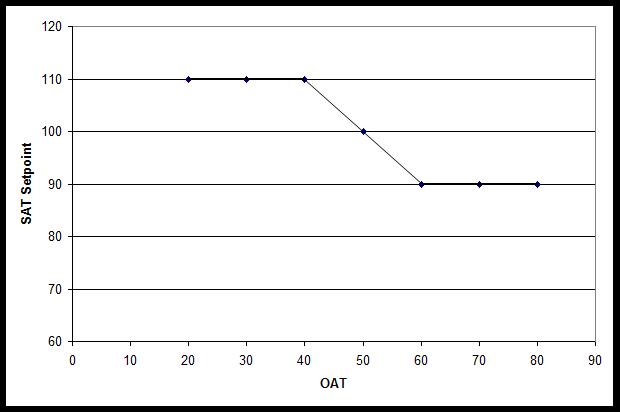
A linear reset schedule that represents the heating supply air temperature or hot deck supply air temperature (for dual duct systems) as a function of outdoor air dry-bulb temperature. This schedule is defined by the following data points (see below):
Figure 3.7.2-2: Example of SAT heating setpoint reset based on outdoor air temperature (OAT) |
|
Units |
Data structure (°F) |
|
Input Restrictions |
As designed |
|
Baseline Rules |
Not applicable |
This section addresses building descriptors related to heating and preheating control. Section 3.7.6 addresses all other details related to heating systems.
|
Preheat Setpoint |
|
|---|---|
|
Applicability |
Systems 5 though 8 |
|
Definition |
The control temperature leaving the preheat coil |
|
Units |
Degrees Fahrenheit (°F) |
|
Input Restrictions |
As designed |
|
Baseline Building |
The baseline will be modeled with preheat coil in the mixed air stream controlled to a fixed setpoint 20°F less than the design room heating temperature setpoint |
|
Heating Supply Air Temperature |
|
|---|---|
|
Applicability |
All systems |
|
Definition |
The SAT leaving the air handler when the system is in design heating mode (not the air temperature leaving the reheat coils in VAV boxes) |
|
Units |
Degrees Fahrenheit (°F) |
|
Input Restrictions |
As designed |
|
Baseline Building |
20°F above zone temperature setpoint for systems 1 through 4 and 12 through 13. Same as maximum reset cooling SAT for systems 5 through 8 and 105°F for systems 9 and 10. For baseline system 11, the heating supply air temperature shall be modulated to maintain space temperature and fan volume shall be fixed at minimum airflow. |
|
Heating Supply Air Temperature Controls |
|
|---|---|
|
Applicability |
Systems with the capability to vary heating SAT setpoint |
|
Definition |
The method of controlling heating SAT. Choices are:
|
|
Units |
Degrees Fahrenheit (°F) |
|
Input Restrictions |
As designed |
|
Baseline Building |
No control is specified for heating SAT for systems 1 through 4, 9, 10, and 11 through 13. For systems 5 through 8, the heating SAT is fixed to the maximum reset cooling SAT. |
|
Heating Reset Schedule by Outside Air |
|
|---|---|
|
Applicability |
Systems that reset the heating SAT by outside dry-bulb temperature (this typically applies to dual-duct systems or to single zone systems with hydronic heating coils) |
|
Definition |
A linear reset schedule that represents the heating SAT or hot deck SAT (for dual duct systems) as a function of outdoor air dry-bulb temperature. This schedule is defined by the following data points (see Figure 10):
Figure 10. Example of SAT Heating Setpoint Reset based on Outdoor Air Temperature. |
|
Units |
Data structure (°F) |
|
Input Restrictions |
As designed |
|
Baseline Building |
Not applicable |
This section addresses building descriptors related to heating and preheating control. Section 3.7.6 addresses all other details related to heating systems.
|
Preheat Setpoint |
|
|---|---|
|
Applicability |
Systems 5 though 8 |
|
Definition |
The control temperature leaving the preheat coil |
|
Units |
Degrees Fahrenheit (°F) |
|
Input Restrictions |
As designed |
|
Baseline Building |
G3.2 New Construction/Major Alterations The baseline will be modeled with preheat coil in the mixed air stream controlled to a fixed setpoint 20°F less than the design room heating temperature setpoint. G3.3 Minor Alterations Baseline shall be modeled such that the preheat coils have controls that stop their heat output whenever mechanical cooling, including economizer operation, is occurring. Exception: the preheat setpoint should be modeled the same in the baseline and proposed if, based on the requirements of 90.1-2022 Section 6.1.4 and the scope of the alteration, 90.1-2022 Section 6.5.2.5 requirements are inapplicable. |
|
Heating Supply Air Temperature |
|
|---|---|
|
Applicability |
All systems |
|
Definition |
The SAT leaving the air handler when the system is in design heating mode (not the air temperature leaving the reheat coils in VAV boxes) |
|
Units |
Degrees Fahrenheit (°F) |
|
Input Restrictions |
As designed |
|
Baseline Building |
G3.2 New Construction/Major Alterations 20°F above zone temperature setpoint for systems 1 through 4 and 12 through 13. Same as maximum reset cooling SAT for systems 5 through 8 and 105°F for systems 9 and 10. For baseline system 11, the heating supply air temperature shall be modulated to maintain space temperature and fan volume shall be fixed at minimum airflow. G3.3 Minor Alterations Same as proposed. |
|
Heating Supply Air Temperature Controls |
|
|---|---|
|
Applicability |
Systems with the capability to vary heating SAT setpoint |
|
Definition |
The method of controlling heating SAT. Choices are:
|
|
Units |
Degrees Fahrenheit (°F) |
|
Input Restrictions |
As designed |
|
Baseline Building |
G3.2 New Construction/Major Alterations No control is specified for heating SAT for systems 1 through 4, 9, 10, and 11 through 13. For systems 5 through 8, the heating SAT is fixed to the maximum reset cooling SAT. G3.3 Minor Alterations Baseline shall be modeled as minimally compliant with Standard 90.1-2022 Section 6.5.3.5. Standard 90.1-2022 Section 6.5.3.5 requires that multiple zone HVAC systems be modeled to automatically reset the supply air temperature in response to representative building loads or outdoor air temperature. The controls should be modeled to reset the supply air temperature at least 25% of the difference between the design supply air temperature and the design room air temperature. Controls that adjust the reset based on zone humidity are allowed to be modeled in Climate Zones 0B, 1B, 2B, 3B, 3C, and 4 through 8. HVAC zones that are expected to experience relatively constant loads should be modeled to have a maximum air-flow to accommodate the fully reset supply air temperature. Exceptions to 6.5.3.5:
Exception: the heating supply air temperature control should be modeled the same in the baseline and proposed if, based on the requirements of 90.1-2022 Section 6.1.4 and the scope of the alteration, 90.1-2022 Section 6.5.3.5 requirements are inapplicable. |
|
Heating Reset Schedule by Outside Air |
|
|---|---|
|
Applicability |
Systems that reset the heating SAT by outside dry-bulb temperature (this typically applies to dual-duct systems or to single zone systems with hydronic heating coils) |
|
Definition |
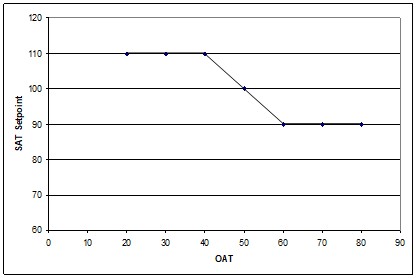
A linear reset schedule that represents the heating SAT or hot deck SAT (for dual duct systems) as a function of outdoor air dry-bulb temperature. This schedule is defined by the following data points (see Figure 10):
Figure 10. Example of SAT Heating Setpoint Reset based on Outdoor Air Temperature. |
|
Units |
Data structure (°F) |
|
Input Restrictions |
As designed |
|
Baseline Building |
G3.2 New Construction/Major Alterations Not applicable G3.3 Minor Alterations See the Heating Supply Air Temperature Controls descriptor for baseline requirements. |